
The Origins and Identity of the Brand
Beca: Laura, we would love to learn a little more about you. How did your journey within the fashion industry begin, and what inspired you to create THE AOFD?
Laura Franco: Ever since I was a little girl, I knew I wanted to study fashion design. I was already familiar with some of the most prestigious international fashion schools, but at the time, I wasn’t in a position to move abroad to pursue my studies.
Fashion has always been a part of my life. Growing up, I would ask for books, magazines and perfumes as birthday presents — anything that could bring me closer to the world of fashion.
Fortunately, my mother also had a great appreciation for clothing and always wore beautifully made, high-quality pieces. From a very young age, she instilled in me the importance of making purchasing decisions based on quality above anything else.
Considering my circumstances at the time, I realised that graphic design could potentially be my gateway into the fashion industry, especially because I also had a deep fascination with magazines, books and editorial design.
I began researching my academic options and considered three institutions in Mexico: the Escuela de Diseño del Instituto Nacional de Bellas Artes (EDINBA), the Universidad Autónoma Metropolitana (UAM), and the Escuela Nacional de Artes Plásticas (ENAP).
I took the entrance examinations for all three universities and, fortunately, was accepted into each of them. Ultimately, I decided to attend the Escuela de Diseño de Bellas Artes, which I still believe was the best decision I could have made.
The programme offered a comprehensive approach to design, encompassing textiles, graphic design and object design. Naturally, I became particularly immersed in the textile courses and workshops.
After several years of working in design and running my own design agency, I woke up one day with this almost impulsive desire to finally create my own clothing brand. It was a moment of realisation: Yes, this is something I truly want to do.
I got together with a couple of friends, and we began having weekly calls. At the time, I was living outside Mexico while they were based there. One of them specialised in business, while the other owned a garment production workshop in Mexico.
We began building the business from the ground up, carefully evaluating every aspect of the brand. We developed business frameworks, matrices and went through all those processes that, from my perspective, can feel a little overwhelming and somewhat tedious when starting a business. Nevertheless, we did them all.
Meanwhile, I immersed myself in the creative side of the project, developing the logo, working on the design and creating my first sketches.
Architecture has always been a significant source of inspiration for me. At the time, I became particularly fascinated by the Brutalist buildings I encountered in London, especially those at the Barbican Centre.
Those monumental architectural structures became the starting point for my creative exploration. I began developing sketches inspired by Brutalist architecture.
Beca: What was the inspiration behind THE AOFD, and what is the meaning behind the brand’s name? What story do you seek to tell through your designs?
Laura Franco: The inspiration behind the brand stemmed from a reflection on the current state of the fashion industry. There are already far too many clothing brands in the world, far too many garments, and an overwhelming amount of fast fashion.
I believe fashion is no longer what it once was. If we look back at the last century, clothing communicated a great deal about a person’s social status. Nowadays, it is incredibly easy to purchase and accumulate clothing, particularly because the value of a garment has been significantly diminished.
My business partners and I would often have conversations about the fashion industry and its business landscape. One day, we came to a realisation: The world doesn’t need another clothing brand.
The textile industry is already saturated with products, ranging from beautifully crafted pieces to poorly made garments. There is simply so much of everything.
One of my greatest sources of inspiration has always been the Mexican fashion designer Marika Vera.
I have always regarded her as an icon, from the way she constructs her garments to her minimalist aesthetic, her photography and her campaigns.
Eventually, we began exploring the idea of creating a lingerie brand that would be practical yet sensual, moving away from conventional elements such as bows and lace. We wanted to distance ourselves from those traditional codes and embrace simplicity and transparency instead.
That is how THE AOFD came to life.
The name references The Accommodations of Desire, a well-known painting by Salvador Dalí.
There is also a slightly nerdy story behind the name. My business partners’ names begin with the letters A and D, and I have a middle name that I rarely use, which also begins with an A.
Ultimately, the name became a combination of these two concepts, bringing together an artistic reference and a personal connection between the founders.
Lingerie as a Form of Fashion Expression
Beca: . Traditionally, lingerie has been regarded as intimate apparel. Today, however, we are increasingly seeing it incorporated into the everyday wardrobe. How do you interpret this evolution, and what role does THE AOFD play in this new approach to dressing?
Laura Franco: From the very beginning, THE AOFD was conceived and carefully designed so that lingerie would not be limited to intimate wear. The idea was to create pieces that could be styled with other garments and seamlessly incorporated into everyday outfits.
In fact, for a series of photographs I took at Central Saint Martins, my friend Liz helped me bring this concept to life. The idea was to style a shirt with a bralette worn over it, rather than underneath.
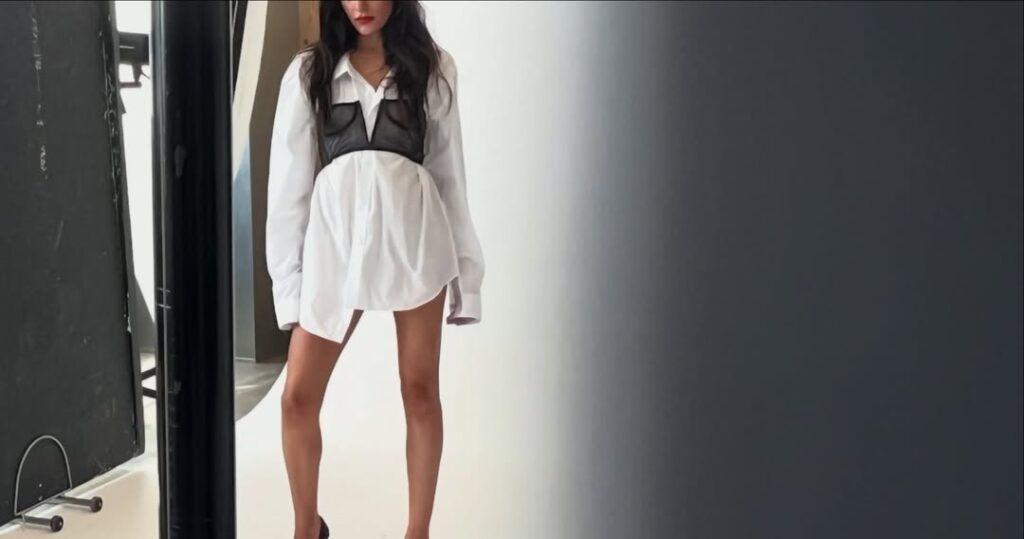
It was about taking an intimate garment, making it visible and allowing it to elevate what might otherwise be a simple shirt.
The same philosophy applies to our bodysuits. They are intentionally designed to be worn with a pair of jeans or casual trousers, making them versatile pieces that can easily become part of an everyday wardrobe.
Ultimately, the intention behind THE AOFD is to create lingerie that feels sexy and sensual while maintaining a sense of simplicity.
Beca: One of the aspects that particularly draws us to your work is the way you explore sensuality through an elegant and sophisticated lens. How do you strike a balance between femininity, sensuality and contemporary design?
Laura Franco:I think we have long been immersed in the world of established lingerie brands that everyone used to gravitate towards, such as Victoria’s Secret, Agent Provocateur and La Perla.
Personally, I always found these brands incredibly beautiful, particularly because of their exquisite fabrics and luxurious silks. However, I feel that in recent years, some of that essence has gradually been lost.
I wanted to create something entirely different, something much more minimalist that would celebrate women’s bodies while moving away from expressions of sensuality that I personally felt were overly explicit.
I wanted to create something more thoughtfully designed. My intention has always been to celebrate the beauty of the human body and encourage people to feel comfortable in their own skin.
That philosophy became the foundation of my design process. I wanted to design for different body types, ensuring that every woman who wears my pieces feels beautiful, elegant and, above all, comfortable.
I believe there is nothing more uncomfortable than wearing underwear that is too tight or made from overly synthetic fabrics.
Ultimately, all these considerations led me to create this brand, and I appreciate that you perceive it as a more sophisticated approach to lingerie.
Beca:. In contemporary fashion, designers such as Nensi Dojaka have explored the relationship between lingerie, structure and the female body. Which designers, artistic movements or cultural references have influenced your own creative vision?
Laura Franco: Yes, Nensi Dojaka has always been a great source of inspiration for me. I’ve had the opportunity to see her garments up close on several occasions and appreciate their construction and craftsmanship. I think she is an incredible designer.
I believe everything has influenced my creative journey. As I have always said, including in conversations with the people I have worked with, design is nourished by culture, history and politics. Everything is interconnected.
I firmly believe in what certain theorists suggest: that dressing is a political act. The way you dress says a great deal about who you are. There is something quite subtle yet revealing about what a person’s clothing can communicate about them.
I draw inspiration from many different sources, from books and theatre to ballet, which I absolutely love.
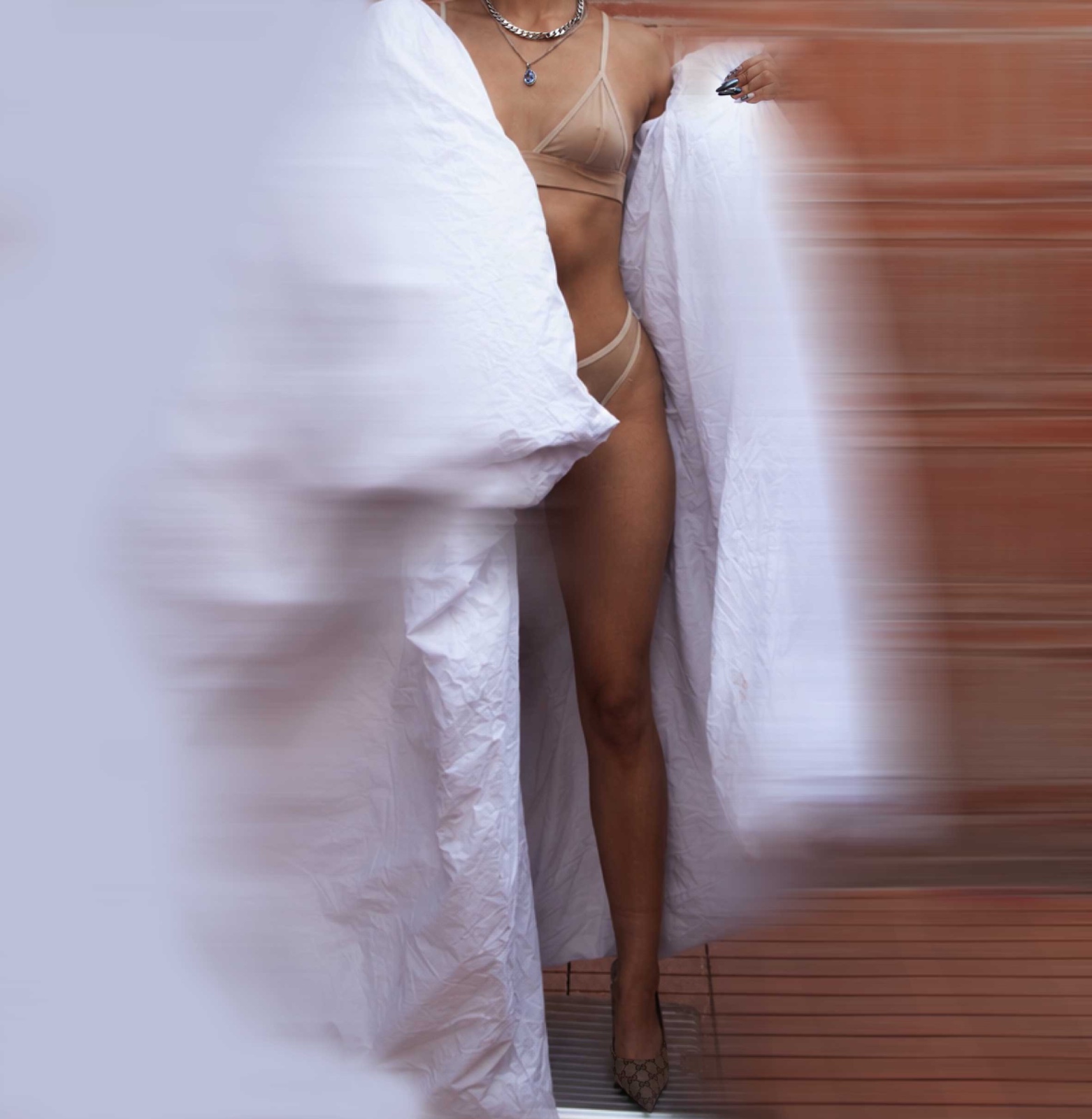
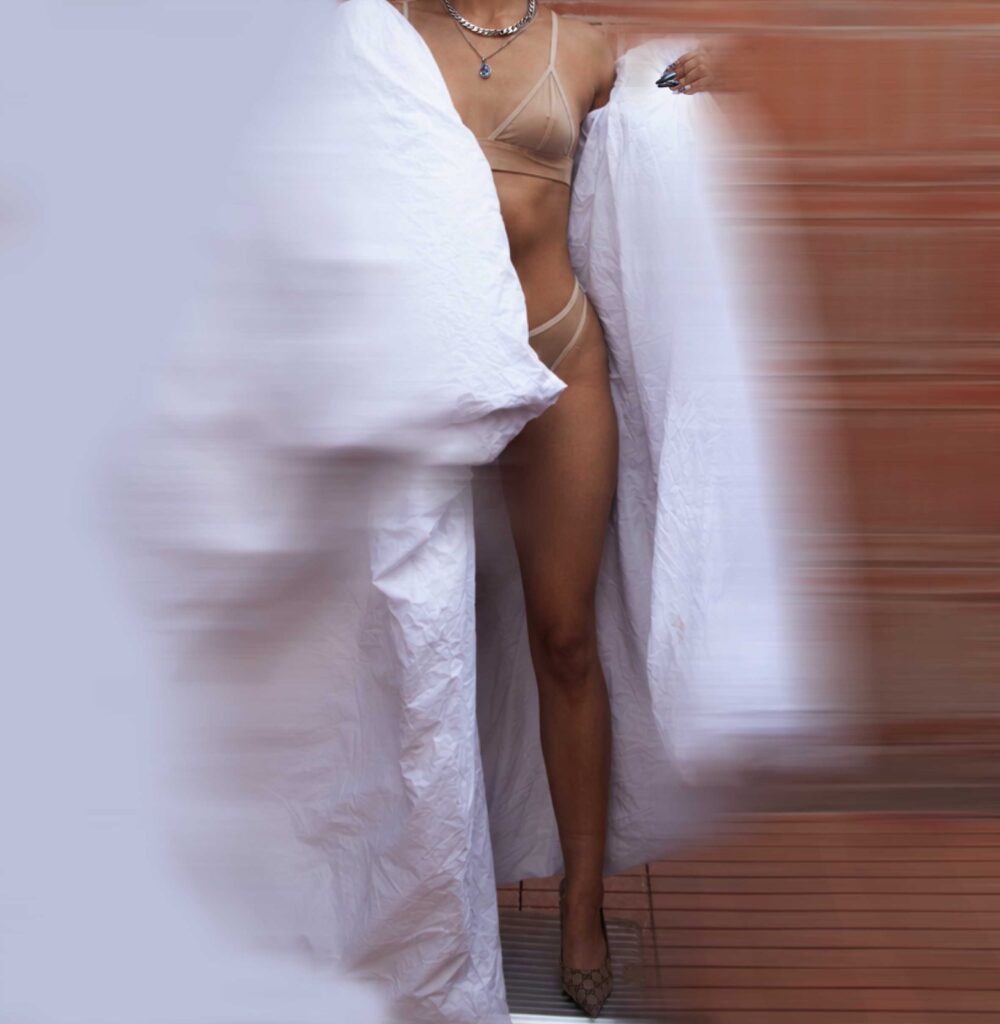
Ballet, in particular, has been a fascinating source of inspiration. If you look at the nude-coloured pieces in my collection, you can see how colour completely transforms the perception of a garment.
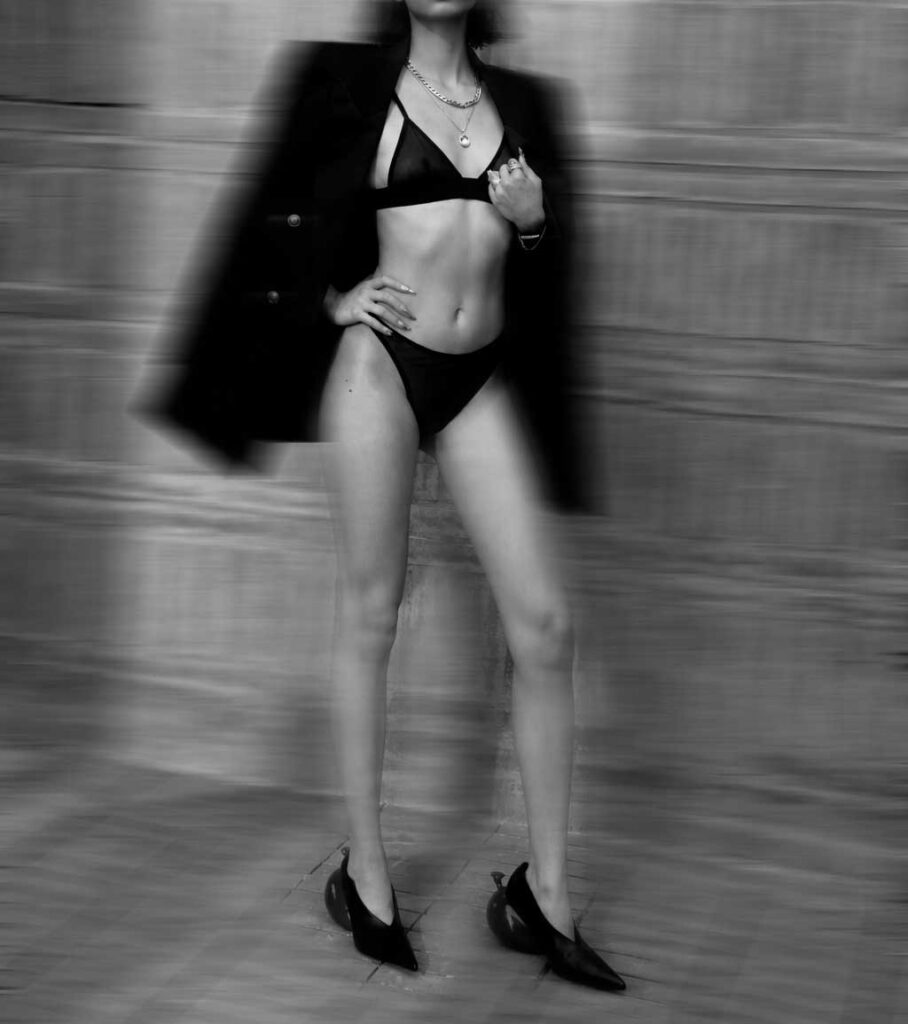
It might be exactly the same design, the same bralette, but transitioning from black to nude gives the piece an entirely different character. I feel that nude tones make the garments appear much more feminine, creating an aesthetic reminiscent of a ballerina.
I find inspiration in countless places: a wonderful book, flowers, nature and so many other things.
I have also always deeply admired the work of great designers such as Alexander McQueen. There was another British designer whose name escapes me at the moment (Gareth Pugh), whose work had a distinctly Gothic aesthetic.
I believe these creative visionaries have revolutionised the way we dress. Take Gabrielle Chanel, for instance, who transformed the way women dressed and encouraged them to feel comfortable in their clothing.
Ultimately, I believe that all these references, experiences and cultural influences have shaped the way I approach design.
The Creative Process and the Female Body
Beca: What does your creative process look like when developing a collection? Do you begin with a silhouette, a particular material or an emotion you wish to convey?
Laura Franco: For this particular collection, my inspiration was deeply rooted in Brutalist architecture, its use of concrete and its heavy, monumental forms.
What fascinates me about concrete is its inherent duality. It can have an incredibly delicate texture while simultaneously appearing raw and rugged.
I believe it is precisely this juxtaposition between delicacy and the ruggedness of architectural forms that defines my collection.
Beca: Lingerie has a particularly intimate relationship with the body, as it must combine aesthetics, functionality and comfort. What are the main challenges you face when designing your pieces?
Laura Franco: We went through an extensive sampling process. In the early stages, we began developing samples through video calls, as I was living in London while my business partners were based in Mexico. It was incredibly challenging to assess garments through a screen.
I believe there is something fundamental about the physical experience of clothing. Garments may look beautiful in photographs online, but nothing compares to seeing a piece in person, touching it, feeling its texture and trying it on.
This became a significant challenge for us. At one point, we even put the process on hold because I couldn’t physically examine the garments, which became increasingly frustrating throughout the creative and development process.
A garment might look beautiful and perfectly functional in my sketches and illustrations, but when it came to construction, the fabrics didn’t always behave as expected.
Once I returned to Mexico, where I am currently based, the entire process became much easier.
It was particularly important to me that the garments felt comfortable against the body while still providing structure. We made numerous technical adjustments, and I worked closely with our pattern cutter, Caro, to refine every detail.
Ultimately, the most important thing for me was ensuring that the finished garment looked exactly as I had envisioned it in my original sketch. I wanted it to reflect the way I had conceived, considered, designed, drawn and illustrated it.
For me, being able to translate that initial creative vision into a tangible garment is incredibly important.
It was a technical challenge on many levels, but it was equally challenging to ensure that the garments felt genuinely comfortable when worn.
We developed several samples and made numerous adjustments before arriving at the final pieces.
I believe I have been fortunate to work with an incredible team. I continue to collaborate with talented pattern cutters and garment makers who help me transform my creative vision into reality, ensuring that each piece becomes what I originally imagined.
Beca: What role do materials, sheer fabrics and construction details play in shaping the visual identity of THE AOFD?
Laura Franco: For me, fabrics are an incredibly important part of the design process.
A textile engineer who taught me at university once emphasised the importance of surrounding ourselves with natural textiles. She often spoke about materials such as cotton and linen and their relationship with our bodies.
Our skin is our largest organ, so when choosing fabrics that come into direct contact with it, she encouraged us to consider natural materials whenever possible.
However, achieving the necessary elasticity in natural fabrics without incorporating synthetic materials such as elastane or nylon can be extremely challenging.
Material selection is particularly important because even within the same type of fabric, there can be significant differences in quality.
Our fabrics are sourced from Italy, and this was a very deliberate decision. Initially, I wanted everything to be made in Mexico, using Mexican textiles. However, we struggled to find fabrics that felt soft to the touch, did not cause friction against the skin and met the exceptional quality standards I was looking for.
Ultimately, I decided that we needed to import our fabrics to offer our customers — or rather, the women who wear our pieces — a higher standard of quality.
I understand that this decision increases overall production costs, but I firmly believe that when you invest in a higher-quality garment, it will last longer, and you are more likely to take better care of it.
We also incorporate cotton into very specific areas of our lingerie, particularly in sections that come into direct contact with parts of the body where the use of cotton is especially important.
That was something I really wanted to prioritise throughout the design and development process.
Femininity, Identity and the Women Who Wear THE AOFD
Beca: Today, the concept of femininity is constantly evolving. What does designing for the contemporary woman mean to you, and how is that vision reflected in THE AOFD?
Laura Franco: I think femininity is a particularly interesting concept to explore. This collection was conceived exclusively in two colours: black and nude. Each colour gives the garments an entirely different meaning.
A nude-coloured bodysuit feels incredibly feminine and delicate, whereas black bodysuits, in my opinion, carry a stronger sense of power, one that feels more masculine.
For me, it has always been incredibly important to demonstrate that women can thrive on their own terms. We don’t need a male figure by our side to achieve our goals.
One of the things I find most fascinating is witnessing the transformation in someone’s facial expression when they put on one of my garments. I can see how empowered they feel, how their confidence changes, and even how they begin to stand a little taller.
That is precisely what excites me when someone wears a piece from THE AOFD.
I feel that these garments carry an incredibly strong emotional resonance. They make you feel powerful, sexy and, at the same time, exceptionally comfortable and deeply feminine.
I believe it is incredibly important not to lose touch with our femininity or our sensuality.
Beca: How would you describe the woman who wears THE AOFD? Beyond her personal style, what attitude or approach to fashion do you believe she shares with your brand?
Laura Franco: I believe the women who have purchased and worn pieces from THE AOFD are incredibly powerful women within their respective fields.
What I find particularly interesting is that these garments allow them to embrace their femininity in a way that makes them feel empowered.
They are women who embody strength, and I feel that wearing these pieces allows them to express their femininity as a source of power.
The Future of THE AOFD
Beca: From your perspective as an independent designer, what opportunities and challenges do you currently see for brands specialising in lingerie within the Mexican fashion industry?
I won’t deny that garment production has been a significant challenge. Lingerie is particularly difficult and complex to produce because it involves working with extremely delicate fabrics.
The construction process is entirely different from that of a T-shirt or a pair of jeans. It requires specialised machinery, different types of thread and an entirely different approach to garment construction.
I am only just beginning the commercial side of the brand, but production has already proven to be quite challenging.
For me, designing is perhaps the easiest part. The business side — budgeting, production, delivery schedules, sales and photography — is what I find most complicated.
As someone who has been designing for many years, the creative process is the enjoyable part. It’s the fun part, the one that comes most naturally to me.
Building a business around something you are deeply passionate about is an entirely different experience. It can be emotionally exhausting and, at times, frustrating. You cry, you laugh, and throughout the journey, you experience a rollercoaster of emotions.
I also believe that one of the greatest challenges in Mexico is encouraging people to truly appreciate and understand the value of clothing. I think this is something particularly complex within our society.
In other countries, people are accustomed to investing in high-quality garments created by extraordinary designers, even when those pieces come with a higher price tag. They appreciate their value and understand why things cost what they do.
In Mexico, I believe this particular market is still developing and growing.
I would love to see people choose to own five beautifully made, high-quality garments rather than twenty pieces in their wardrobe.
However, that shift in consumer mentality remains a significant challenge.
Beca: Do you believe lingerie is moving away from being designed exclusively for the gaze of others and is increasingly being understood as a form of personal expression for the wearer?
Laura Franco: There are still many taboos surrounding lingerie. However, I have always approached it in much the same way as choosing a beautiful pair of jeans, a lovely shirt or a great pair of shoes. I believe choosing beautiful underwear is equally important.
It goes beyond wearing something for someone else. Of course, if you have a partner, regardless of their gender, it can be wonderful to share that intimate side of yourself with them.
However, I believe that once you begin to accept your body and work on different aspects of yourself, dressing your body becomes something truly fascinating.
I distinctly remember reaching a point in my life when I began to feel very comfortable in my own skin. I believe that experience inspired me to dress differently, choosing garments that accentuated the features I loved most about my body.
There is something beautiful about underwear because it is so intimately connected to you.
It brings us back to something I have mentioned throughout this conversation: the importance of comfort. It is about wearing something that makes you feel comfortable while simultaneously providing structure to your body, encouraging you to stand taller and feel more confident.
Sometimes, that sense of comfort translates into something as subtle as a change in the way you walk or carry yourself.
It’s difficult to put into words, but I believe that feeling comfortable in what you wear can genuinely transform the way you carry yourself.
One of the guiding principles behind THE AOFD has always been to make each person feel more beautiful in their own body.
Lingerie is simply a vehicle for something greater. My true intention is for every woman who wears these pieces to feel more beautiful, more comfortable, more attractive and more empowered.
Ultimately, I want these garments to amplify the qualities that already exist within every woman.